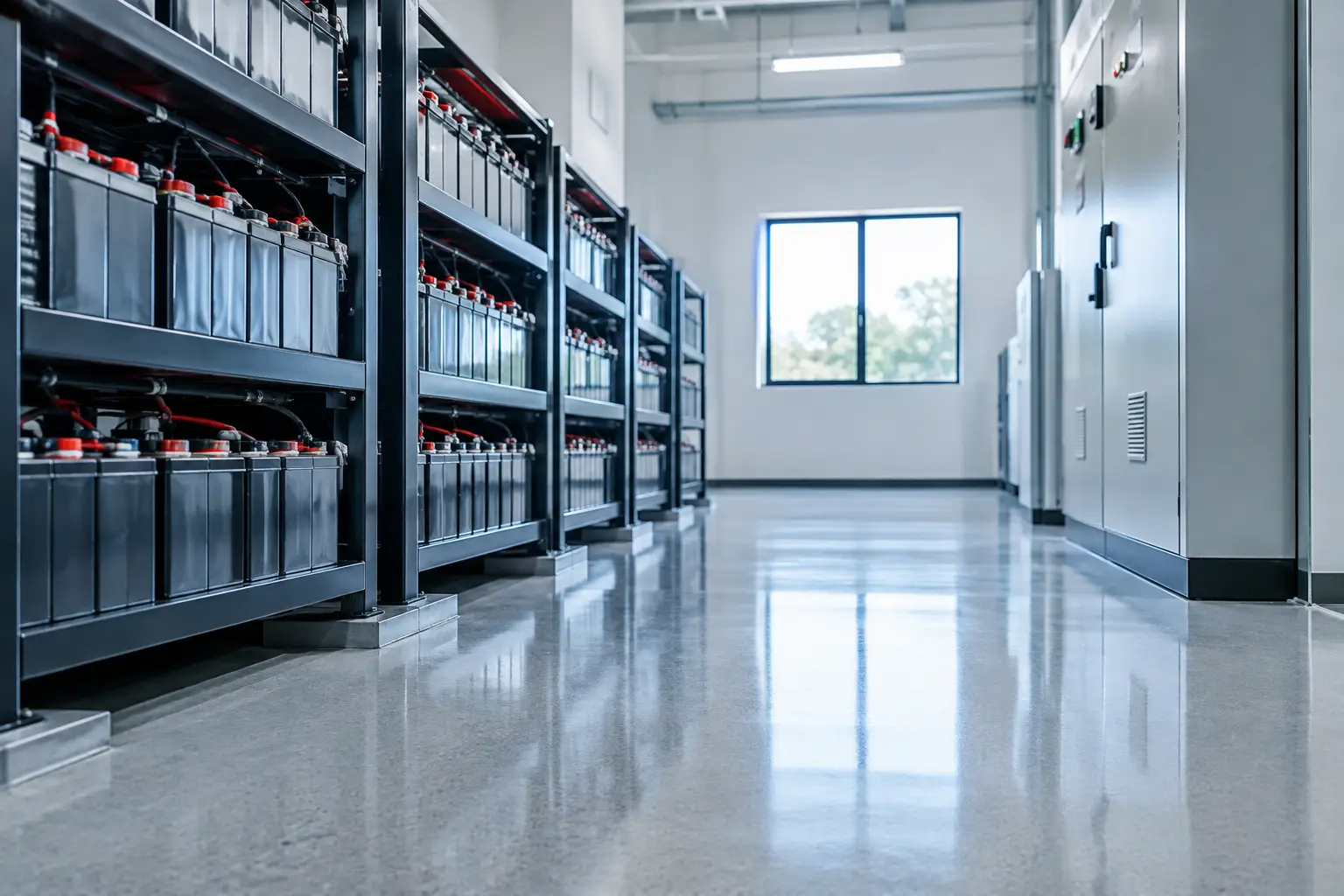
A battery room floor is not a finish selection. It is part of the facility’s safety, containment, maintenance, and uptime strategy. The best floors for battery rooms resist the chemicals actually present, prevent liquids from reaching the concrete, remain cleanable under demanding conditions, and hold up at the details where most failures begin.
For facility managers and project teams, the central question is not simply whether a coating is chemical-resistant. It is whether the complete floor system - substrate preparation, resin selection, wall transitions, penetrations, drains, and installation quality - matches the battery technology and operating conditions in the room.
What Battery Room Floors Must Handle
Battery rooms are not all exposed to the same risks. A room serving flooded lead-acid batteries may face sulfuric acid drips, splashes, and corrosive residues around charging and maintenance areas. A lithium-ion battery room may have lower routine acid exposure, but still requires a durable, cleanable floor that supports equipment movement, spill response, and facility fire-protection requirements. Nickel-cadmium systems create a different chemical profile again.
That distinction matters. A floor specified for general warehouse traffic may look acceptable on day one, yet fail quickly when acid reaches unprotected concrete, coating pinholes, joints, or wall edges. Once chemicals migrate beneath a coating, the result can be blistering, delamination, concrete deterioration, and an avoidable shutdown.
A properly designed system should address chemical resistance, impact and abrasion, cleanability, moisture conditions in the slab, slip resistance, and the ability to form a continuous containment surface. The floor must also suit the actual traffic pattern. Battery rooms with lift trucks, pallet jacks, battery handling equipment, or service carts need more than a thin coating selected only for chemical exposure.
Best Floors for Battery Rooms by Operating Risk
For most industrial battery rooms, high-build resinous flooring is the strongest starting point. The best material depends on the chemistry, exposure intensity, concrete condition, and expected traffic.
Novolac Epoxy for Acid Exposure
Novolac epoxy systems are commonly specified where strong chemical resistance is required, particularly in lead-acid battery rooms. Compared with standard epoxy, novolac formulations offer a higher level of resistance to aggressive chemicals when selected and installed for the specific exposure.
These systems can be built as thicker coatings or mortar systems, depending on the condition of the slab and the expected service loads. They provide a dense, jointless surface that is easier to clean and can be extended up walls to create an integral cove base. That cove is not a cosmetic upgrade. It removes the vulnerable floor-to-wall joint where spilled liquid can reach the substrate.
Novolac epoxy is not a universal answer. Surface preparation is critical, as is verifying the system’s resistance to the actual acid concentration, temperature, and contact duration. A product that performs under occasional splash exposure may not be appropriate for repeated pooling or a failed containment event.
Vinyl Ester for Severe Chemical Service
Where battery-room conditions involve frequent, concentrated, or severe chemical exposure, vinyl ester flooring may be the better choice. Vinyl ester systems are designed for demanding chemical environments and can provide a high-performance barrier over properly prepared concrete.
The trade-off is that vinyl ester installation requires disciplined execution. Working times can be short, substrate conditions must be controlled, and the installation crew must understand the system’s chemistry and detailing requirements. This is not an area for a generic coating application.
For severe-service battery rooms, the added material and installation cost can be justified by lower lifecycle risk. Replacing a failed floor beneath active battery infrastructure costs far more than specifying the proper system before the room is commissioned.
Urethane Cement for Thermal and Physical Demands
Urethane cement is often valuable in industrial spaces that experience thermal cycling, moisture-vapor challenges, washdowns, or heavy physical abuse. It is especially useful when the battery room is part of a broader utility, process, or maintenance area with harsh service conditions.
Its chemical resistance must still be evaluated against the battery chemistry. Urethane cement should not be assumed to replace a novolac epoxy or vinyl ester system in a high-acid environment. In some facilities, a layered approach is appropriate: a urethane cement base for durability and moisture tolerance, paired with a chemical-resistant topcoat selected for the expected exposure.
Static-Control Flooring Where the Risk Assessment Requires It
Static-control or conductive resinous floors may be appropriate in battery rooms containing sensitive electronics or equipment where electrostatic discharge is a documented concern. However, conductivity should never be treated as a default feature.
A conductive floor requires a complete grounding design, testing protocol, and coordination with the facility’s electrical and safety requirements. It also changes the specification and installation process. Select it when the room’s engineering assessment calls for it, not because it sounds like an automatic improvement.
Containment Details Matter as Much as the Field Floor
A chemical-resistant floor is only as reliable as its weakest transition. Many battery-room failures start at door thresholds, drains, columns, equipment pads, pipe penetrations, and existing saw cuts. These details need to be planned before installation begins.
Integral cove base is often a sound choice where liquid containment is required. The flooring system continues from the horizontal slab up the wall, eliminating a seam that can trap residue or admit liquid. The height should align with the room’s containment design and anticipated spill volume.
Drains need special attention. In some battery rooms, drains conflict with containment objectives or environmental controls. Where drains are included, the coating system must terminate and seal correctly at the drain body. Cracked grout, exposed concrete, or an unsealed drain perimeter can defeat an otherwise high-quality floor.
Doorways also deserve a specific detail. If the room is intended to contain a spill, the threshold must be compatible with that requirement while maintaining access for equipment and personnel. A low-profile containment curb, sealed transition, or engineered trench detail may be necessary depending on site conditions.
Concrete Preparation Determines Service Life
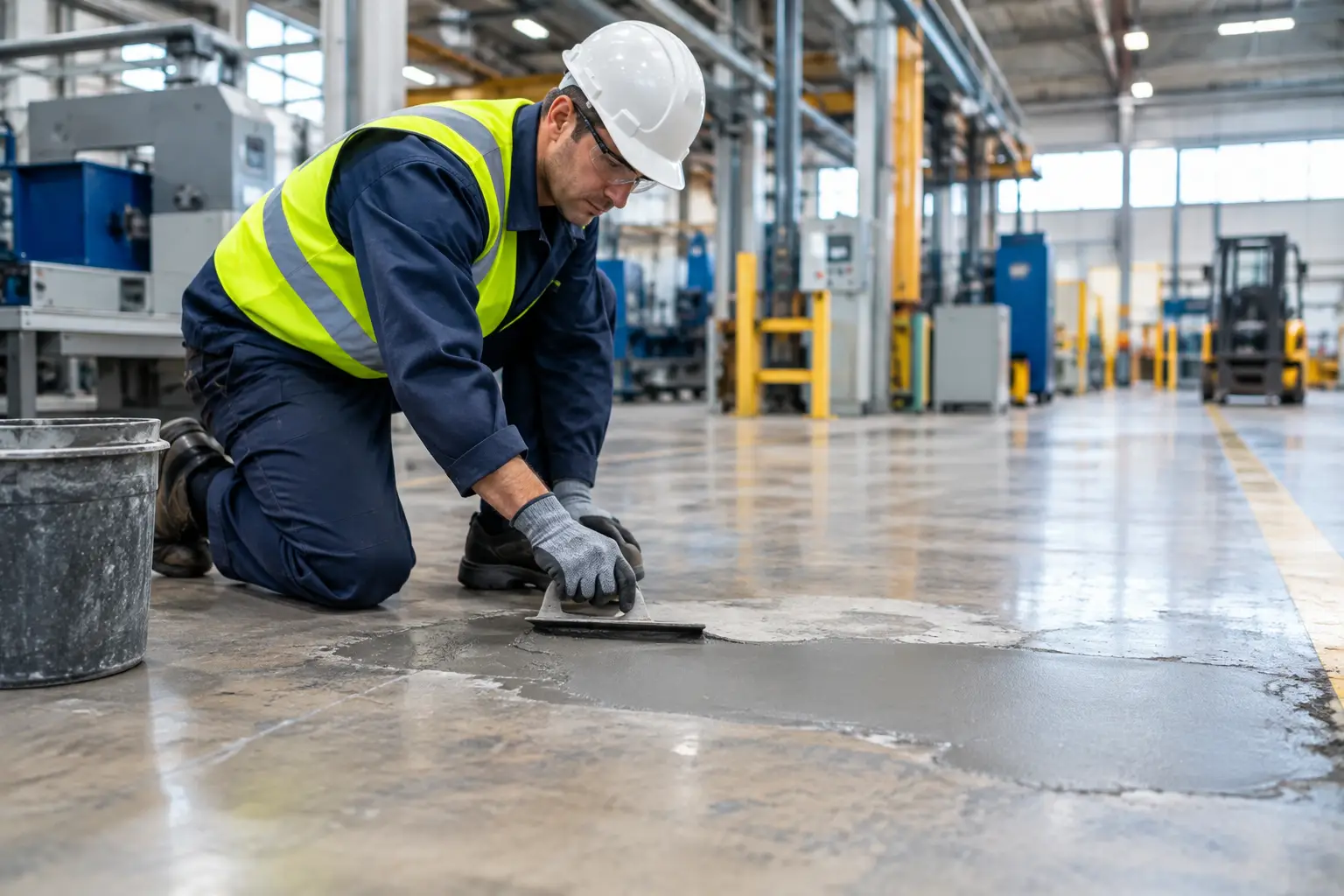
Even the strongest resinous material will not compensate for weak surface preparation. Battery-room slabs frequently have old coatings, oil contamination, patchwork repairs, moisture issues, or acid-damaged concrete hidden beneath equipment.
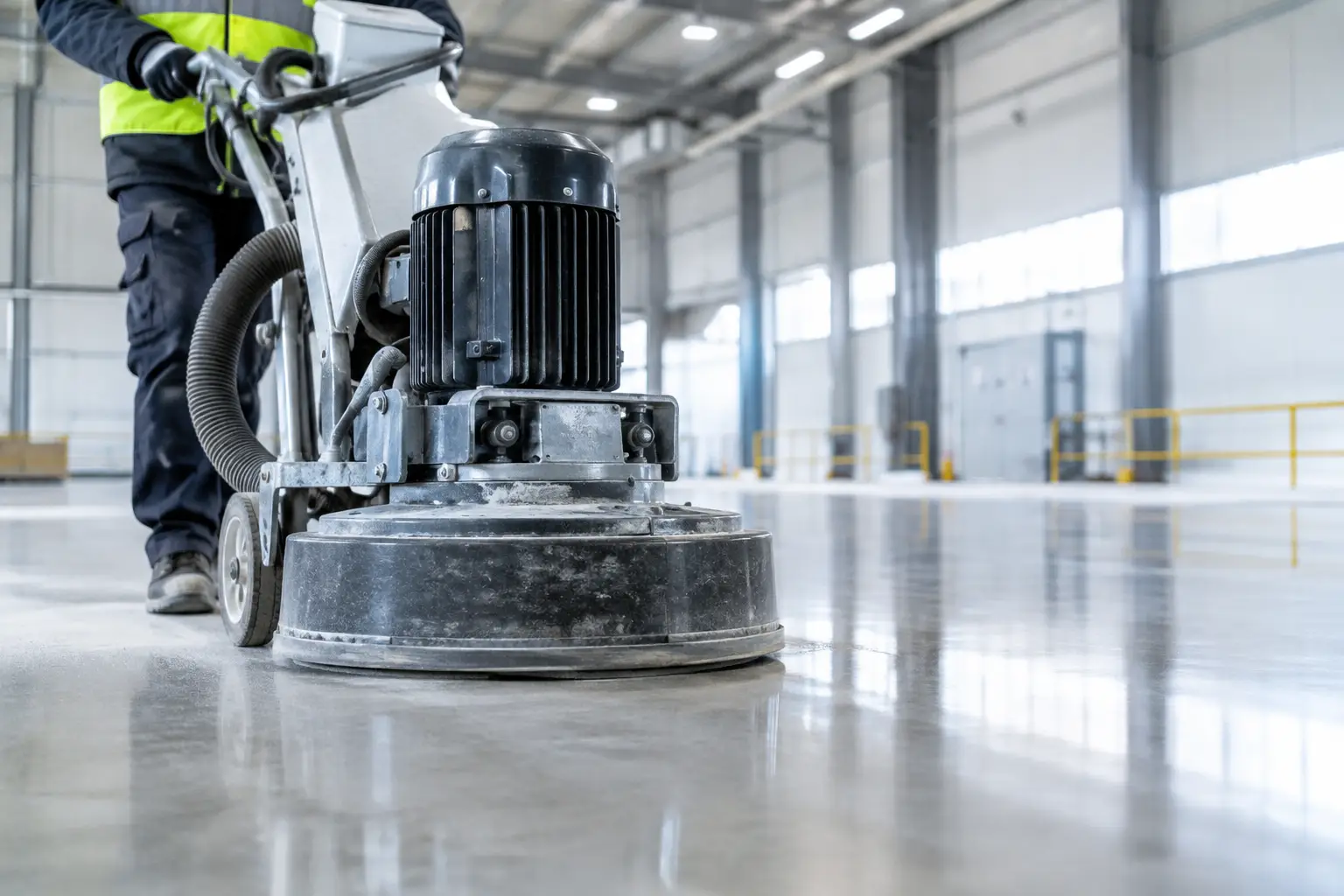
Mechanical surface preparation creates the proper profile for adhesion and removes compromised material. The required profile varies by system thickness, but the principle is consistent: the concrete must be clean, sound, dry enough for the selected material, and prepared to the manufacturer’s requirements.
Acid-damaged concrete may require more than surface grinding. Softened areas, spalls, and deteriorated joints should be removed and rebuilt with compatible repair materials before the new floor is installed. Coating over unsound concrete only transfers the failure to a later date.
Moisture testing should also be part of the pre-installation process. Moisture vapor transmission can contribute to blistering and bond failure, particularly on slabs without effective vapor protection. Where readings indicate a risk, the flooring design may require a moisture-mitigation layer or a system better suited to the slab condition.
Specify for Maintenance and Downtime, Not Just Opening Day
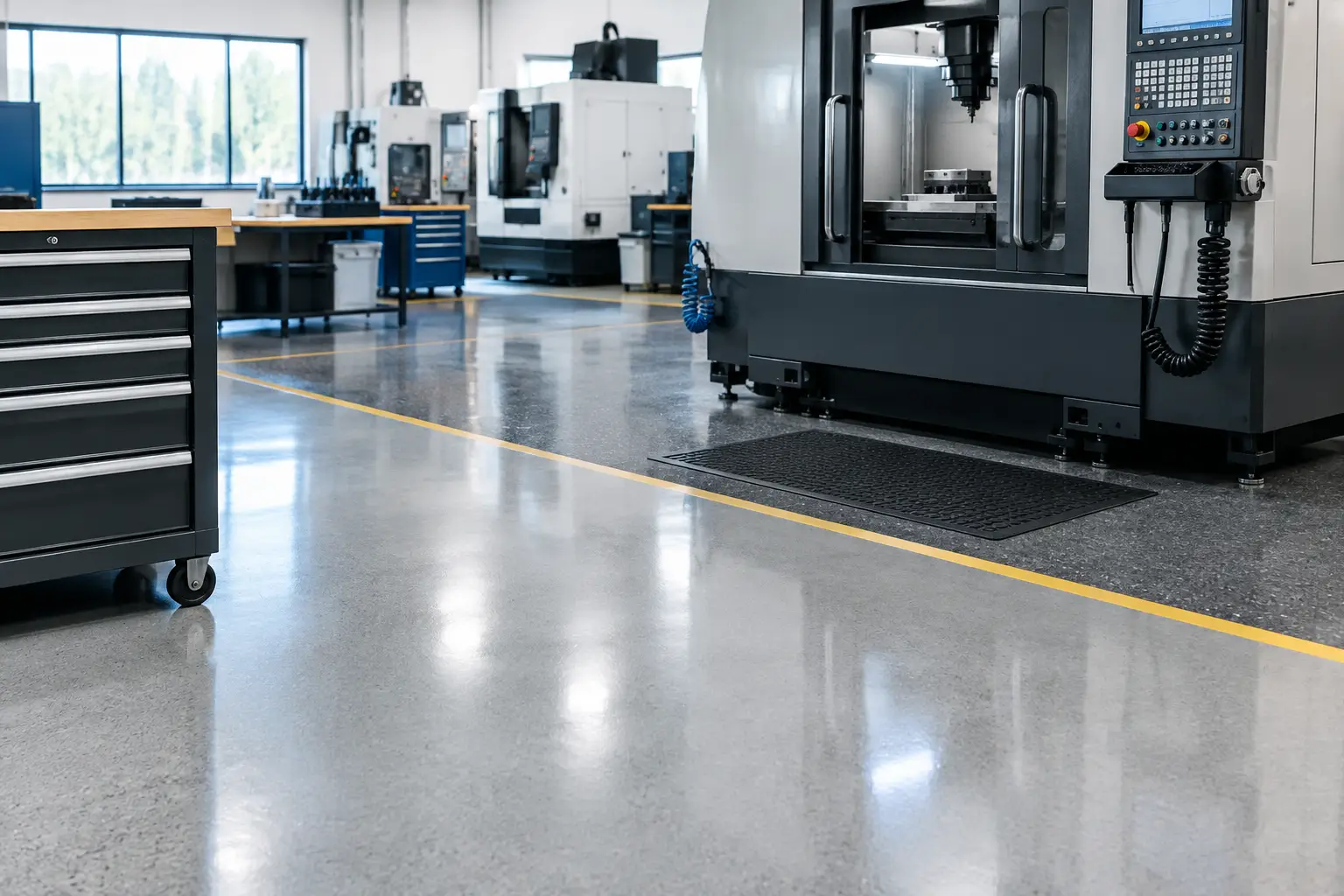
A battery room floor should simplify maintenance. Smooth, jointless systems reduce places for residue to accumulate and make inspections more straightforward. Texture can improve traction, but excessive texture can hold dirt and chemical residue. The right finish balances slip resistance with cleanability based on the room’s housekeeping methods and spill risk.
Color also has a practical role. Light, neutral colors can make leaks, corrosion residue, and debris easier to identify. Safety striping and designated equipment zones can be integrated into the floor when they support operating procedures, but they should not substitute for physical containment or clear safety controls.
Installation sequencing is equally important in active facilities. Battery systems, chargers, ventilation equipment, and access routes can limit the work window. A qualified contractor should plan surface preparation, dust control, cure times, return-to-service requirements, and protection of adjacent operations before mobilization.
A Floor System Should Be Selected as a System
The right battery-room floor is rarely a single product selected from a data sheet. It is a coordinated system built around the battery type, chemical exposure, substrate condition, equipment traffic, containment requirements, and shutdown tolerance.
For conventional lead-acid rooms, a properly detailed novolac epoxy or vinyl ester system is often the strongest path. For physically demanding utility spaces, urethane cement may play an important role. For lithium-ion facilities, the focus may shift toward durable, cleanable protection and coordination with the site’s broader safety plan. Each case requires a specification that reflects actual operating risk.
Osis Group approaches industrial flooring with that full-system view: prepare the substrate correctly, select materials for the service environment, and execute the details that protect long-term performance. A battery room may occupy limited square footage, but its floor supports infrastructure the rest of the operation depends on. Treat it accordingly.