In the evolving landscape of global logistics and industrial manufacturing, the floor is no longer just a surface to walk on; it is a critical piece of operational infrastructure. At Osis Group, we have witnessed a significant shift in engineering specifications across Qatar, the UAE, and KSA. Traditional steel mesh reinforcement is rapidly being replaced by Steel Fiber Reinforced Concrete (SFRC).
This transition is driven by the need for higher load-bearing capacities, reduced maintenance overhead, and the precision required for modern VNA (Very Narrow Aisle) warehouses and automated logistics centers.
What is SFRC?
Steel Fiber Reinforced Concrete is a composite material consisting of hydraulic cement, aggregates, and discrete, discontinuous steel fibers. Unlike traditional rebar or welded wire mesh, which are placed in specific planes (often incorrectly during the pour), steel fibers are distributed three-dimensionally throughout the entire concrete matrix.
These fibers—typically ranging from 30mm to 60mm in length with hooked ends for mechanical anchorage—act as a "bridge" across micro-cracks, preventing them from developing into structural failures.
1. Superior Crack Control and Ductility
The primary failure point of any industrial floor is cracking. Traditional reinforcement only begins to work after a crack has reached the steel mesh. By contrast, SFRC provides multi-directional reinforcement.
- Micro-crack Prevention: Because fibers are distributed throughout the mix, they intercept cracks at the microscopic level.
- Post-Crack Load Capacity: Should a crack form, the high tensile strength and mechanical anchorage (hooked ends) of the fibers provide significant "pull-out" resistance, maintaining the floor's structural integrity.
- Ductility: SFRC transforms concrete from a brittle material into one with significant energy absorption (toughness) and ductility.
2. Speed of Construction and Cost-Efficiency
For large-scale projects like airport hangars or regional distribution centers, time is a critical cost factor. SFRC offers massive logistical advantages:
- Elimination of Mesh Placement: Manually laying, cutting, and chairing steel mesh is labor-intensive and prone to error. With SFRC, the reinforcement is added at the batching plant or directly into the truck mixer.
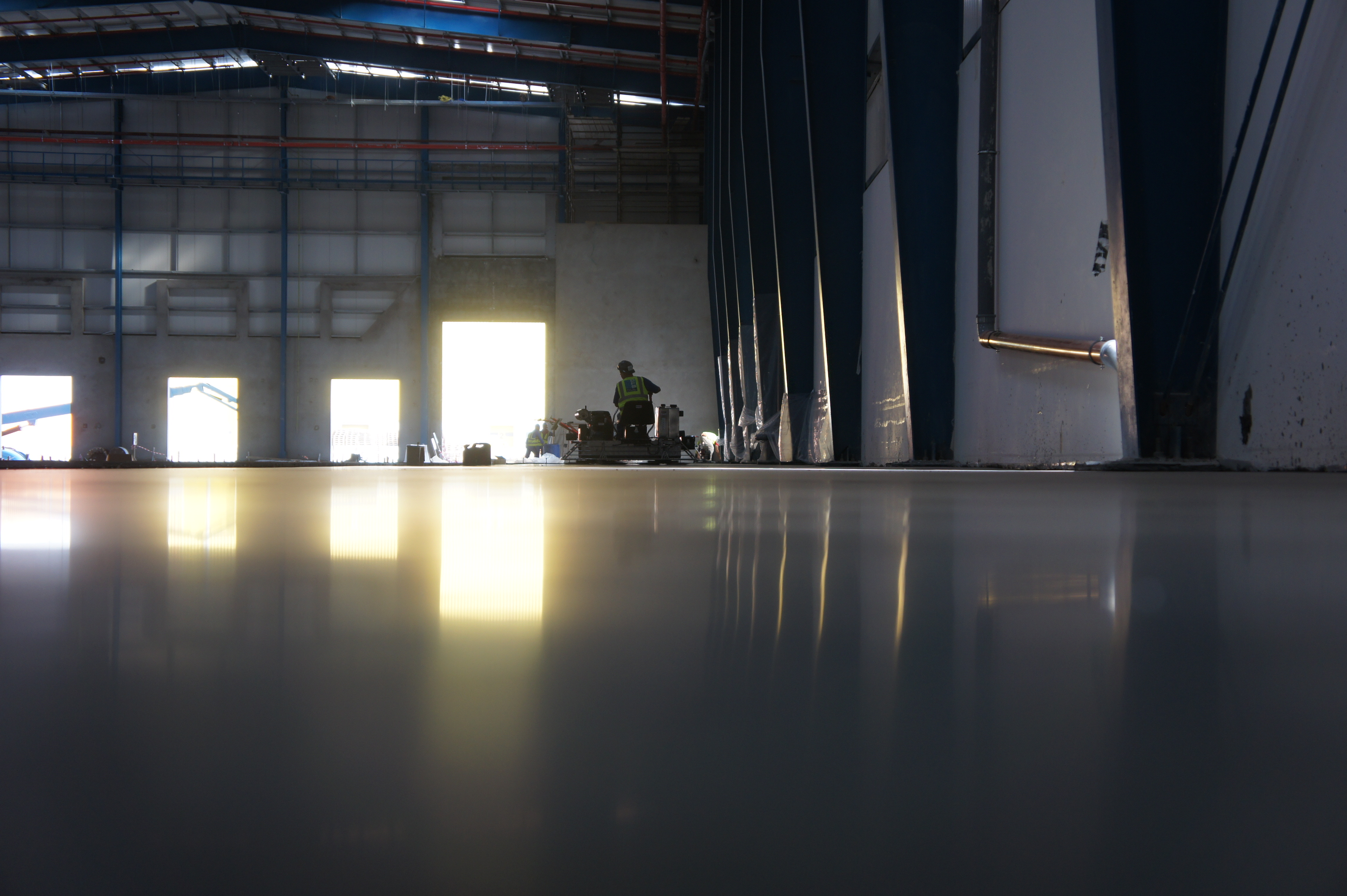
- Laser Screed Compatibility: At Osis Group, we utilize advanced Laser Screed technology. When combined with SFRC, we can pour significantly larger areas per day (up to 2,000m²+) without the physical obstruction of rebar, ensuring a faster project turnaround.
- Reduced Labor Costs: Fewer workers are needed on-site for steel fixing, reducing both the payroll and the health and safety risks associated with handling heavy steel mesh.
3. Compliance with International Standards (TR34)
Modern warehousing demands extreme precision. The Concrete Society’s TR34 (Technical Report 34) is the global benchmark for industrial floor design. SFRC is a preferred material for achieving FM2 and FM1 (Special) classifications.
- Jointless Floors: SFRC allows for the design of "jointless" floors, where saw-cut contraction joints can be spaced much further apart (up to 40m or 50m) compared to the standard 6m grid. Fewer joints mean fewer points of impact for forklift wheels, which is the leading cause of floor maintenance issues.
- High-Tolerance VNA Floors: In Very Narrow Aisle environments, where wire-guided pallets operate at heights of 15+ meters, the stability provided by SFRC is essential for maintaining the required flatness tolerances over time.
4. Enhanced Impact and Abrasion Resistance
In heavy-duty environments like cargo terminals or manufacturing plants, floors are subjected to heavy impact from falling loads and consistent abrasion from hard-wheeled traffic.
- Impact Resistance: Research shows that SFRC can have up to 5 to 10 times the impact resistance of plain concrete. The fibers hold the matrix together under dynamic loading.
- Surface Integrity: When combined with high-quality dry-shake hardeners, SFRC creates a surface that resists delamination and "spalling" much more effectively than mesh-reinforced slabs.
5. Optimized Load Transfer
Industrial floors must support massive static loads from racking systems (often exceeding 10 tons per leg) and dynamic loads from forklifts. Steel fibers enhance the shear strength of the concrete.
In a traditional slab, loads are transferred via the concrete and the soil subgrade. In an SFRC slab, the fibers ensure that the load is distributed across a wider area, reducing the stress on the sub-base and preventing localized "pumping" or subsidence.
The Osis Group Approach: Engineering the Perfect Slab
Simply adding fibers to a mix is not enough. Achieving a high-performance floor requires a holistic engineering approach:
- System Design: We work with structural engineers to determine the correct fiber dosage (e.g., 20kg/m³ to 40kg/m³) based on the specific racking loads and soil conditions (K-value).
- Fiber Selection: Depending on the application, we select fibers with specific aspect ratios (length/diameter) to ensure the required residual flexural strength.
- Mix Optimization: We ensure the concrete mix design has the correct workability (slump) to allow for even fiber distribution without "balling."
- Joint Stabilization: For jointless designs, we implement armored joints (steel-faced) to protect the header of the slab where the fibers end, ensuring 100% load transfer between panels.
Conclusion
Steel Fiber Reinforced Concrete is the backbone of the "Floor as a Machine" philosophy. By eliminating the weaknesses of traditional mesh—such as incorrect placement and joint vulnerability—SFRC provides warehouse owners in the Gulf and Europe with a lower Total Cost of Ownership (TCO).
Whether you are developing a cold-storage facility in Qatar or a high-traffic logistics hub in Saudi Arabia, SFRC is the key to a durable, low-maintenance, and high-precision floor.
Contact Osis Group today to discuss how we can implement SFRC and Laser Screed technology for your next industrial project.